TypeSafe launches Jev, the first “System One” model: AI decisions in milliseconds to automate processes
TypeSafe AI unveils Jev, a model that returns structured decisions with calibrated probability in 70 to 500 ms. What it is, what it promises, what it means.
Ideas más Ideas team
AI implementation
6 min read
In this article
On 28 September 2026, the AI lab TypeSafe AI unveiled Jev, the first model in a new family that the company calls “System One”. Unlike large language models, Jev is not designed to converse or write, but to make fast, structured decisions that software can use directly. It is already available in early access.
What TypeSafe AI is
TypeSafe AI is an artificial intelligence lab founded by Diogo Almeida, a former OpenAI researcher. Its goal is to build what it calls machine-native intelligence infrastructure: models designed to decide inside automation software, not to talk to people.
What System One models are
The name refers to “system 1”, the fast, intuitive mode of thinking. According to TypeSafe, these models differ from language models in three ways:
- They return structured, typed values with a calibrated probability, instead of free text.
- They process the answer in parallel rather than generating it word by word, which greatly reduces latency.
- They are trained with a proprietary reinforcement learning technique aimed at calibrated decisions, which the company calls RLCD.
TypeSafe sums up the idea as a function call with frontier intelligence: unstructured information and the program’s state go in, and a typed decision with its probability comes out.
An example to make it clear
Imagine the inbox of a distribution company that receives hundreds of emails a day, each of which has to be sent to the right department. This is how it is solved today with a language model:
// With a language model: the decision is requested as text and has to be interpretedconst reply = await llm.generate( `Classify this email as: customer_service, billing, logistics or sales. Reply with the category only. ${email}`);// reply: "I think it's logistics, because the customer is asking about their shipment."// → the text has to be cleaned up, the category validated and retried if it does not exist// → it takes seconds and charges for every word generatedAnd this is how TypeSafe sets out the same step with Jev: the program defines the possible options and the model can only return one of them, with its probability.
// With a System One model such as Jev: the decision arrives already typed and with a probabilitytype Department = 'customer_service' | 'billing' | 'logistics' | 'sales'; const decision = await jev.decide<Department>({ input: email, // free text, exactly as it arrives options: ['customer_service', 'billing', 'logistics', 'sales'],});// decision: { value: 'logistics', probability: 0.94 } (70–500 ms) if (decision.probability >= 0.9) routeTo(decision.value, email);else escalateToPerson(email); // a person resolves the doubtThe practical difference: there is no text to interpret, the answer never strays from the intended options, and the probability makes it possible to decide automatically when to act and when to pass the case to a person.
The figures the company announces
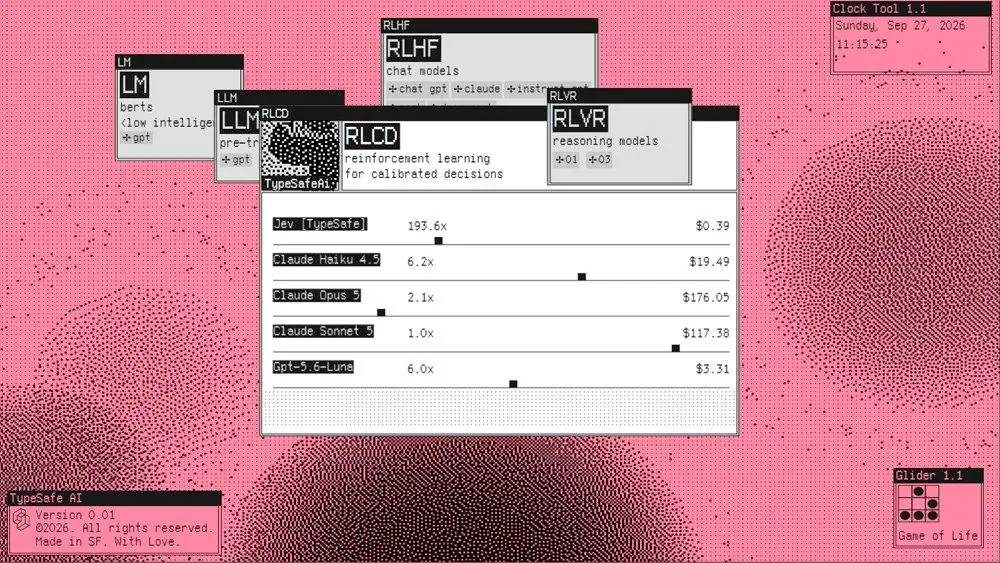
- Response time of 70 to 500 milliseconds, compared with the seconds or minutes of frontier language models on workflow tasks.
- In its automation tests, up to 193 times faster and 444 times cheaper than the models compared.
- A price of 0.042 dollars per million input tokens; output tokens are not charged.
- Because it always returns values of the expected type, the company states that it cannot produce formatting errors or invented answers outside the defined options.
The evaluations compare Jev with several state-of-the-art language models and are published by TypeSafe. These are the company’s own figures, not yet independently verified.
What it could mean for business automation
Many business processes do not need AI to write, but to decide: which department an email goes to, whether an order has an incident, what type of document a PDF is, whether an invoice matches the order or what priority a ticket has. Today these decisions are handled by language models that are slower and more expensive than necessary for such a narrow task.
If the figures are confirmed, models like Jev could make those decisions cheaper and faster inside AI agents, especially in high-volume processes such as document classification, query routing or order validation.
Language models will still be needed to converse and write. What is new is having a specialised component, faster and cheaper, for the decisions inside each process.
Our take
This is a trend we see clearly: AI agents in production combine several models, each doing what it does best. Jev is in early access, so before using it in a critical process it is advisable to validate its accuracy, its limits and where the data is hosted in real cases. At Ideas más Ideas we follow these models closely so that we can incorporate them when they deliver measurable savings for our clients.
Source and image: official announcement by TypeSafe AI, “Introducing System One models and Jev” (typesafe.ai), 28 September 2026. The code examples are illustrative and do not correspond to the official API.
Want to know which decisions in your processes can be automated with AI?